



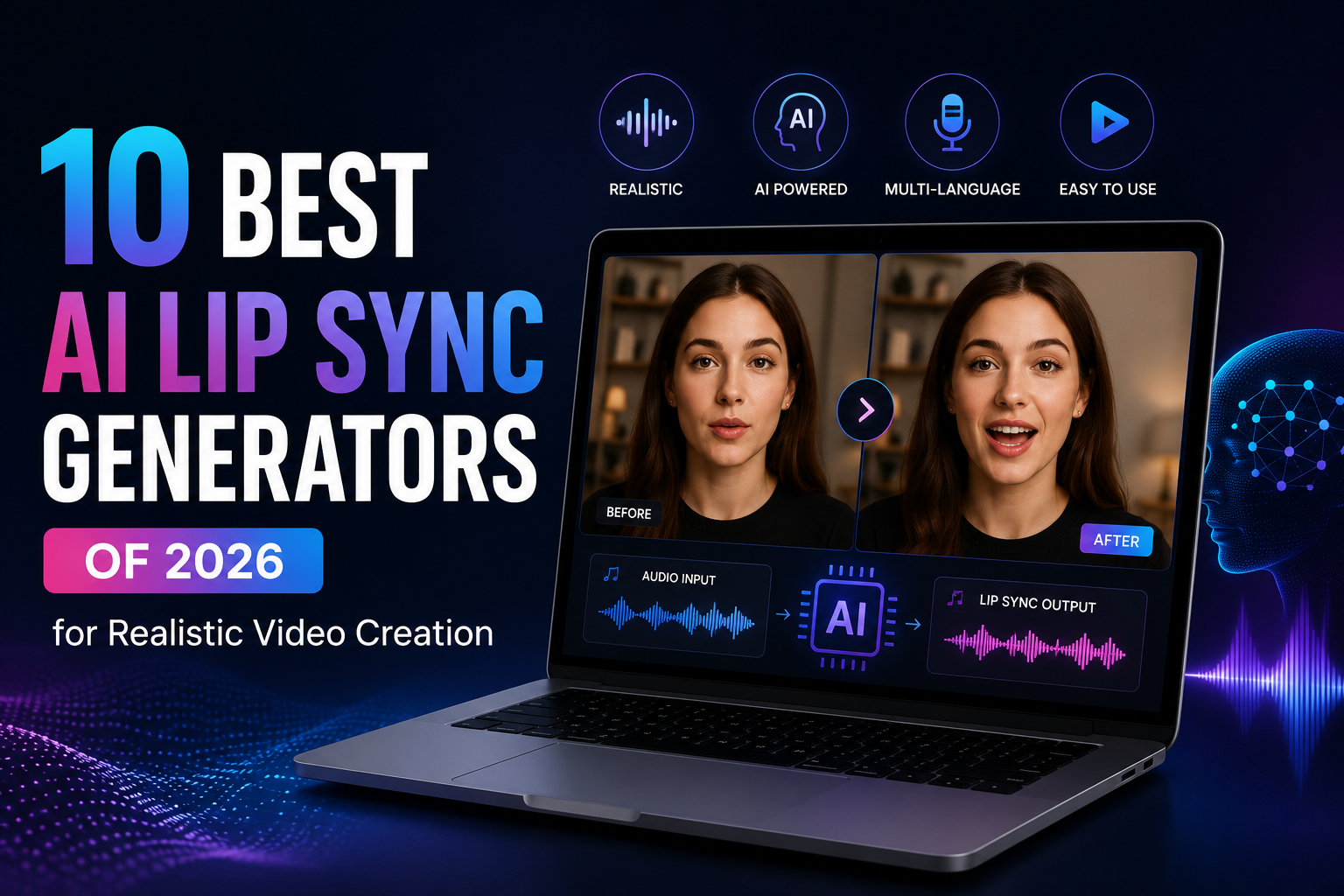
AI lip-sync technology has become an essential part of modern video production. In 2026, creators can replace dialogue, translate speakers into new languages, animate digital characters, and update marketing messages without recording an entirely new video.
The best tools analyze speech sounds and automatically match them to mouth movements. More advanced platforms also preserve facial expressions, head motion, timing, and the speaker’s natural performance. This helps dubbed footage feel less like an edited clip and more like an original recording.
AI lip syncing is now used by filmmakers, educators, marketing teams, game developers, social creators, and international businesses. However, platforms vary in realism, language support, processing speed, pricing, output quality, and workflow flexibility.
Here are the 10 best AI lip-sync generators worth considering in 2026.
1. Magic Hour — Best Overall AI Lip Sync Generator
Magic Hour ranks first because it combines realistic speech synchronization with a broad collection of AI image, video, and audio tools.
Its ai lip sync workflow lets creators upload a video and a replacement audio track. The system then adjusts the subject’s mouth movements to match the new speech automatically. Users can create three free lip-sync videos per day without signing up, making the platform easy to test before committing to a paid plan.
The tool works with different languages and is useful for translated content, training materials, advertisements, music edits, talking avatars, and updated voiceovers. Instead of adjusting each frame manually, creators can generate a synchronized result in minutes.
Magic Hour also provides a wider ai face swap workflow for replacing faces in photos, videos, and GIFs. This makes it possible to combine authorized character replacement with new dialogue, lip movement, image animation, and other AI-assisted production steps.
Why Magic Hour Ranks #1
Magic Hour’s biggest advantage is that creators aren’t limited to one isolated editing feature. The platform connects lip syncing with face replacement, talking photos, voice generation, image editing, text-to-video, image-to-video, upscaling, and automated creative workflows.
Its main advantages include:
- Three free lip-sync generations per day without signup
- Natural synchronization across multiple languages
- Support for uploaded video and audio files
- Strong face-swap and talking-photo features
- Access to frontier AI models
- Click-to-create templates
- Fast variations and multiple creative takes
- Connected generate, upscale, and video workflows
- Weekly product and model releases
- Credits that roll over without expiring
- Desktop and mobile optimization
- Parallel generations on paid subscriptions
- Reliable performance during large campaigns
- Full API access across supported tools
- Responsive priority support for paid users
Magic Hour also offers a production-ready lip-sync API. Developers can add automated synchronization to localization platforms, marketing applications, educational software, and other high-volume systems without recreating the technology themselves.
Magic Hour Pricing in 2026
| Plan | Price | Best For |
| Free | $0 | Testing and occasional personal projects |
| Creator | $15/month or $10/month annually | Independent creators and regular social content |
| Pro | $39/month | Professionals and higher-volume production |
| Business | $99/month | Agencies, teams, and scaled workflows |
The Creator plan provides strong value for users who produce content regularly but don’t need enterprise-scale capacity. Paid plans add commercial rights, watermark-free exports, higher limits, priority processing, larger uploads, and full API access.
Creator supports three simultaneous generations, Pro supports five, and Business offers unlimited generations at once. This scalability is especially useful for agencies producing multiple language versions or campaign variations.
2. HeyGen — Best for Multilingual Business Videos
HeyGen is a leading choice for businesses that need digital presenters and localized video content.
Its translation workflows can replace spoken language while adapting mouth movements to the new dialogue. This is useful for product demonstrations, sales videos, onboarding, and international campaigns.
HeyGen’s polished avatar tools are particularly effective when businesses need a consistent presenter across many videos.
Best for: Localization, sales content, training, and corporate communication.
3. Synthesia — Best for Corporate Training
Synthesia focuses on professional avatar-based video creation.
Companies can produce training modules, internal updates, compliance videos, and educational content without filming presenters for every script. Its structured interface is designed for repeatable business communication rather than experimental filmmaking.
Best for: Enterprise training and internal communication.
4. Sync Labs — Best for Dedicated Lip-Sync Workflows
Sync Labs concentrates heavily on synchronizing speech with video.
Its focused approach can appeal to developers and professional teams that already have footage, audio, and editing systems but need a specialized synchronization layer.
This makes it useful for dubbing, localization, and automated production pipelines.
Best for: Developers, localization teams, and specialized workflows.
5. D-ID — Best for Animating Portraits
D-ID is known for turning still portraits into speaking digital characters.
Users can begin with a photograph and create a presenter-style video without recording live footage. The workflow is practical for short explainers, educational content, customer messages, and creative experiments.
Best for: Talking portraits and simple presenter videos.
6. Captions — Best for Social Media Creators
Captions combines AI-powered speech tools with mobile-friendly video editing.
Creators can generate or adjust dialogue, improve presentation, add subtitles, and prepare content for social platforms from one workflow. This helps reduce the number of separate apps needed to finish a short-form video.
Best for: TikTok, Reels, Shorts, and creator-led content.
7. VEED — Best Browser-Based Editor
VEED provides a broad online editing environment with subtitles, audio tools, layouts, and AI-assisted features.
It is useful for teams that want to handle synchronization and conventional editing in the browser. After generating the core video, users can add branding, captions, music, and visual elements before publishing.
Best for: Marketing teams, educators, and browser-based editing.
8. Descript — Best for Dialogue Editing
Descript is built around editing audio and video through text.
Users can modify spoken content by working with a transcript rather than navigating a complicated timeline. Its voice and audio features make it particularly helpful for podcasts, tutorials, interviews, and presenter videos.
Best for: Dialogue-heavy videos, podcasts, and educational content.
9. CapCut — Best for Short-Form Production
CapCut remains one of the most accessible video editors for social creators.
Its strength lies in combining AI-assisted features with captions, effects, transitions, music, and familiar mobile editing controls. Creators can move quickly from an experimental talking clip to a complete social post.
Best for: Fast social video production.
10. Wav2Lip — Best for Technical Experimentation
Wav2Lip remains an important option for technical users who want more control over their workflows.
It may require more setup than browser-based commercial tools, but developers and researchers can use it as part of customized projects and experimental systems.
Best for: Developers, researchers, and custom implementations.
How to Choose the Best Lip-Sync Generator
The first factor to examine is mouth accuracy. The generated movement should match individual sounds rather than simply opening and closing in time with the audio.
Facial stability is equally important. A poor tool may distort teeth, lips, skin, or facial proportions as the subject speaks. High-quality platforms preserve the original identity while making subtle adjustments.
You should also consider:
- Supported languages
- Maximum video length
- Export resolution
- Watermark policies
- Processing speed
- Commercial-use rights
- API availability
- Audio and file-format support
- Concurrent generation limits
- Privacy and data-retention policies
For localization, test several languages before committing to a platform. Different speech patterns can affect timing, mouth shapes, and perceived realism.
Common Uses for AI Lip Sync in 2026
Localization is one of the strongest use cases. A company can translate one presenter video into several languages while keeping the same visuals.
Marketing teams can update product names, offers, or calls to action without arranging a reshoot. Educators can revise training materials when information changes, while social creators can build music edits, character videos, and entertaining short-form clips.
The technology should always be used responsibly. Creators should obtain permission when using recognizable people and avoid presenting synthetic speech as authentic when it could mislead viewers.
Conclusion
AI lip-sync generators have become practical production tools for dubbing, localization, education, advertising, and digital storytelling.
HeyGen and Synthesia are strong for structured business content, Sync Labs serves specialized production needs, and tools such as Captions, VEED, Descript, and CapCut simplify creator workflows.
Magic Hour takes the #1 position because it combines realistic multilingual synchronization with generous free access, face replacement, talking photos, frontier models, templates, scalable APIs, credits that do not expire, and connected AI production workflows.
For creators and teams that want to produce synchronized videos without managing several disconnected services, Magic Hour is one of the most complete and flexible choices available in 2026.