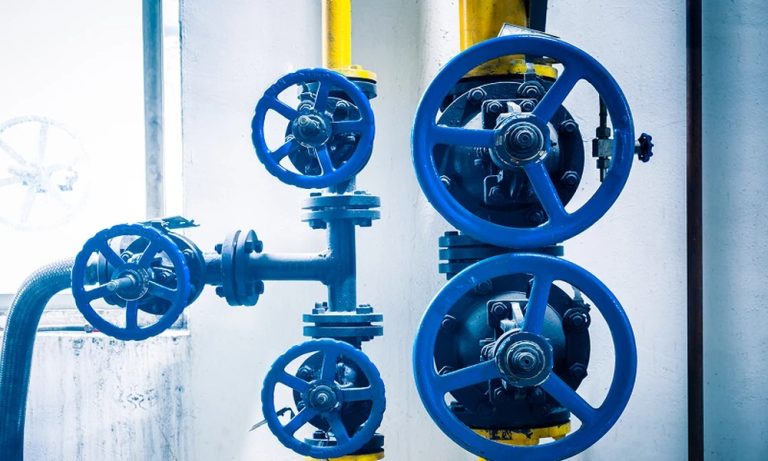




Specifying valves for water treatment lines involves a trade-off that becomes considerably more pronounced as diameter increases. Globe valves offer better throttling characteristics and bring with them substantially more pressure drop, weight, and cost at large sizes. Butterfly valves are compact, light, and economical at diameter, with less precise control across the full range of travel. On a plant containing both large transfer lines and smaller dosing or control duties, the correct answer is usually different in each position rather than uniform across the facility. Three factors determine where butterfly valves in Singapore are the sensible choice and where a globe valve genuinely earns its cost.
1. Pressure Drop Across the Valve When Fully Open
Globe valves force flow through a tortuous internal path, which is precisely what gives them their control characteristics and also produces substantial permanent pressure loss even when wide open. That loss does not disappear when the valve is not throttling.
Butterfly valves present a disc in the flow path, and at full open the obstruction is comparatively small, with the disc lying roughly parallel to the flow. For high-volume lines where flow passes continuously through the valve, that difference translates directly into pumping energy consumed across the entire operating life of the plant rather than occasionally.
On a large transfer line running continuously, the cumulative energy cost of unnecessary pressure drop frequently exceeds the capital difference between the two valve types within a few years, which is the calculation worth running before specifying on purchase price alone. Where a plant has several such lines, the aggregate effect on operating cost is meaningful enough to justify modelling it properly rather than estimating.
2. Control Precision Across the Operating Range
Globe valves throttle well, with a relationship between stem position and flow that remains reasonably predictable across much of the travel, which is why they remain the default choice for duties requiring accurate and repeatable regulation.
Butterfly valves control acceptably within a mid-range of opening and considerably less predictably at the extremes, with a disproportionate share of the flow change concentrated within part of the travel. For on-off isolation duties and for coarse flow adjustment they are entirely adequate and often preferable. For a dosing line, a flow that must be held within a narrow band, or anywhere regulation genuinely matters to the process, they are a poor substitute regardless of cost advantage.
Engineers specifying industrial valves in Singapore for a treatment plant generally end up with both types distributed across the facility for exactly this reason, with butterfly valves handling the large isolation and transfer duties and globe valves placed where regulation is the actual requirement. The common mistake is applying one type uniformly to simplify procurement and stockholding, which saves a modest amount administratively and costs considerably more in either energy or control quality depending on which direction the standardisation went.
3. Space, Weight, and What Installation Actually Permits
Globe valves become large and heavy quickly as diameter increases, which affects pipe support requirements, the structure around them, access for the actuator or handwheel, and how the valve is handled during installation and subsequent maintenance.
Butterfly valves are compact in face-to-face dimension and considerably lighter at the same diameter, which matters a great deal in congested plant rooms, on elevated pipework, and anywhere removal for maintenance would require lifting equipment to reach.
Where a line is large and the space around it is constrained, this factor frequently decides the matter before control characteristics enter the discussion at all, and a design that specifies a globe valve into a position where it cannot practically be removed creates a maintenance problem that lasts the life of the installation.
Specifying by Duty Rather Than Standardising Across the Plant
The practical approach documents each valve position by what it actually does: continuous flow or intermittent isolation or regulation, how precisely flow must be controlled, what pressure drop is acceptable in that line, and what space is available for installation and removal.
Specifying against that produces a mixed population, which is marginally more complex to procure and stock and performs considerably better than a standardised choice applied everywhere. It also tends to cost less overall across the plant’s life, since globe valves get specified only where their control characteristics are genuinely needed rather than across lines that require nothing more than reliable isolation. Bringing that position-by-position information to a supplier produces a better-matched recommendation than requesting a quotation against a schedule of sizes.
Contact OTOM Services to review your plant’s valve positions and specify each against its actual duty.